If you grew up hearing Tagalog at the dinner table but answering in English, you are in very good company. Many Filipino-Americans understand far more than they speak. This guide gives you the phrases that open doors, with simple sound-it-out hints, so your next phone call to Lola starts in her language.
How Tagalog sounds, in one minute
Tagalog is friendly to beginners: it is mostly spelled the way it sounds.
- Vowels are short and clean: a as in "father," e as in "bed," i as in "machine," o as in "port," u as in "flute."
- Ng is one sound, like the end of "sing." Ngayon (now) starts with that hum.
- Mga (the plural marker) is said "ma-NGA," not "em-ga."
- Stress matters. The same spelling can change meaning with stress, so listen and copy the rhythm of the people you love.
Greetings and good mornings
- Magandang umaga (ma-gan-DANG oo-MA-ga): good morning.
- Magandang hapon (HA-pon): good afternoon.
- Magandang gabi (ga-BEE): good evening.
- Kumusta ka? (koo-moos-TA ka): how are you? From the Spanish ¿cómo está? See kumusta.
- Mabuti naman (ma-BOO-tee na-MAN): I'm fine.
- Mabuhay! (ma-BOO-hai): welcome, long live, cheers.
To greet an elder, add po: Magandang umaga po. That single syllable turns a greeting into a small bow.
Thank you, please and sorry
- Salamat (sa-LA-mat): thank you. Salamat po to an elder. Maraming salamat (ma-RA-ming): thank you very much. More at salamat.
- Walang anuman (wa-LANG a-noo-MAN): you're welcome.
- Pakiusap (pa-kee-OO-sap): please, when asking a favor. In daily speech, many people simply add paki- to a verb: pakiabot (please pass it).
- Pasensya na (pa-SEN-sha na): sorry, my apologies.
- Makikiraan po (ma-kee-kee-ra-AN): excuse me, may I pass.
Love and affection
- Mahal kita (ma-HAL kee-TA): I love you. See mahal kita.
- Mahal din kita: I love you too.
- Miss na kita: I miss you. Yes, Taglish counts; it is how millions of people actually talk.
- Ingat (EE-ngat): take care. Said at every goodbye, often twice. See ingat.
Po and opo: respect you can hear
Po and opo are the heart of polite Tagalog. Use them with parents, grandparents, elders, and anyone you want to honor.
- Opo means "yes" respectfully. Oo is the casual yes.
- Hindi po means "no" respectfully.
- Po slips into almost any sentence: Salamat po. Kumusta po kayo?
Notice kayo in that last line. Using the plural "you" with one elder is another layer of respect, a bit like the formal "you" in Spanish. Read more on po.
Rule of thumb: if you are unsure whether to say po, say po. No Tita has ever complained that you were too polite.
At the table
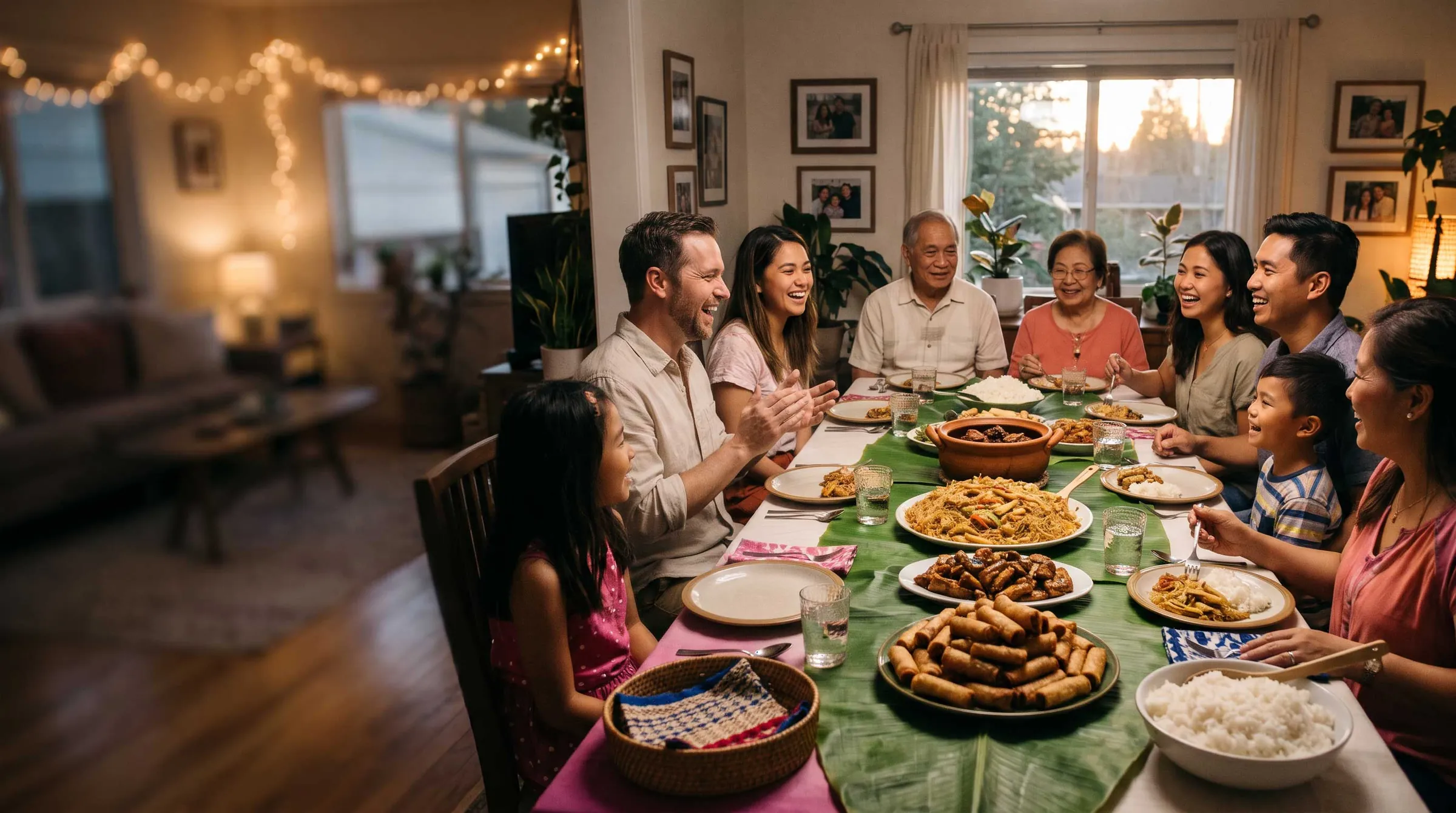
- Kain tayo! (ka-EEN TA-yo): let's eat! The Filipino welcome, offered even to strangers. See kain tayo.
- Masarap! (ma-sa-RAP): delicious. The highest compliment you can pay a cook.
- Busog na ako (BOO-sog): I'm full. Expect a second plate anyway.
Saying goodbye
Filipino goodbyes are famous for taking a while. Expect several rounds of hugs, a plate of leftovers pressed into your hands, and these words:
- Paalam (pa-A-lam): goodbye. A little formal; many people simply say bye or sige.
- Ingat ka or Ingat po: take care.
- Babalik ako (ba-ba-LEEK a-KO): I'll come back.
- Hanggang sa muli (hang-GANG sa MOO-lee): until next time.
A few Bisaya equivalents
Tagalog is the base of Filipino, the national language, but many families speak Bisaya (Cebuano) at home, including our co-founder Emmanuel, who grew up in Cagayan de Oro. If your Lola is from the Visayas or Mindanao, try these:
- Maayong buntag (ma-A-yong BOON-tag): good morning.
- Salamat is shared. Daghang salamat (dag-HANG): thank you very much.
- Kumusta ka? is shared too.
- Gihigugma tika (gee-hee-GOOG-ma TEE-ka): I love you. Many also say Nahigugma ko nimo.
- Oo means yes in both; respect in Bisaya often comes from tone and titles like Manong and Manang rather than po.
Ilocano, Hiligaynon, Kapampangan and many other languages each have their own beautiful versions. Whatever your family speaks is the right place to start.
Quick phrases for real life
- Ano ang pangalan mo? What is your name? Answer: Ako si + your name.
- Saan ka galing? Where are you coming from? Often a friendly hello, not an interrogation.
- Sige (SEE-geh): okay, go ahead, sure.
- Tara! Let's go!
- Teka lang (teh-KA lang): wait a moment. Handy when someone is speaking faster than you can follow.
- Hindi ko alam (hin-DEE ko a-LAM): I don't know. Honest, useful and always forgiven.
- Ay naku! Oh my! Pure feeling, best said with a hand on the chest.
Tips for learning at home
- Ask, do not perform. Elders usually love being asked, "How do you say this, Lola?" It turns a lesson into a conversation.
- Mix freely. Taglish is not cheating. Swap in one Tagalog word per sentence and grow from there.
- Listen first. Filipino songs, teleseryes and family video calls train your ear for rhythm and stress.
- Be gentle with yourself. Someone may laugh at your accent. It is almost always delight, not judgment.
Your next step
Pick one phrase and use it this week. Say Salamat po to an elder, or open a call with Magandang umaga po. Then keep the habit going with our word of the day, one small word at a time. Learn at your pace; every phrase is a thread back home.
Questions people ask
How do you say thank you in Tagalog?
Say Salamat (sa-LA-mat). To be respectful to an elder, say Salamat po. For extra gratitude, say Maraming salamat po, which means thank you very much.
How do you say I love you in Tagalog?
Mahal kita (ma-HAL kee-TA) means I love you. Reply with Mahal din kita, I love you too. In Bisaya, many people say Gihigugma tika.
How do you say good morning in Tagalog?
Magandang umaga (ma-gan-DANG oo-MA-ga). Add po for elders: Magandang umaga po. In Bisaya, the greeting is Maayong buntag.
What does po mean in Tagalog?
Po is a respect marker with no direct English translation. You add it to sentences when speaking to elders or people you want to honor. Opo is the respectful yes; oo is the casual yes.
Is Tagalog the same as Filipino?
Filipino is the national language of the Philippines and is based mainly on Tagalog, with words from English, Spanish and other Philippine languages. In everyday conversation, many people use the two names interchangeably.