Many Filipinos first meet Baybayin on a T-shirt, a tattoo or the corner of a peso bill, and feel an unexpected tug of recognition. That feeling is worth following. Baybayin is one of the oldest threads connecting Filipinos today to their ancestors, and it is simpler to learn than it looks.
What Baybayin is
Baybayin (bai-BAI-yin) comes from the Tagalog root baybay, meaning to spell, and also the shore. It is an abugida: each consonant character carries a built-in vowel sound. That makes it different from the Latin alphabet you are reading now.
You may also hear it called alibata. That name was coined in the 20th century from the first letters of the Arabic alphabet (alif, ba, ta), and many scholars prefer Baybayin.
A short history
Scholars generally trace Baybayin to the Brahmic family of scripts from South and Southeast Asia, likely by way of the Kawi script of Java. The exact path is still debated, and new research keeps the conversation lively.
When the Spanish arrived in the 16th century, they recorded that many people in the Tagalog region could read and write it, often on bamboo or palm leaves with a knife or stylus. Writing on such perishable materials is one reason few early examples survive.
- 1593: the Doctrina Christiana, among the first books printed in the Philippines, set Tagalog in both Latin letters and Baybayin.
- 1620: a Spanish friar introduced a cross-shaped mark to cancel the built-in vowel, so words could end in a consonant.
- Over the following centuries, the Latin alphabet replaced Baybayin in everyday use.
Related scripts never disappeared. The Hanunó'o Mangyan and Buhid of Mindoro and the Tagbanwa of Palawan still keep living traditions of their own scripts, which were inscribed on UNESCO's Memory of the World register as the Philippine Paleographs in 1999.
How Baybayin works
There are 3 vowel characters: A, E/I, and O/U. Baybayin treats e and i as one sound, and o and u as one sound.
There are 14 consonant characters, each read with a built-in "a":
- BA, KA, DA/RA, GA, HA, LA, MA
- NA, NGA, PA, SA, TA, WA, YA
Notice that DA and RA share a character, and NGA has its own, since ng is a single sound in Philippine languages.
The kudlit
The kudlit is a small mark, a dot or short dash, that changes the vowel:
- Kudlit above the character: the vowel becomes e or i. BA becomes BI.
- Kudlit below the character: the vowel becomes o or u. BA becomes BU.
- No kudlit: the vowel stays a.
Ending in a consonant
Traditional Baybayin simply did not write a final consonant; readers filled it in from context. Modern writers usually add a vowel canceller, either the Spanish-era cross or a slash-like mark called the pamudpod (the virama in Unicode), placed below the character. So BA with a canceller reads as just B.
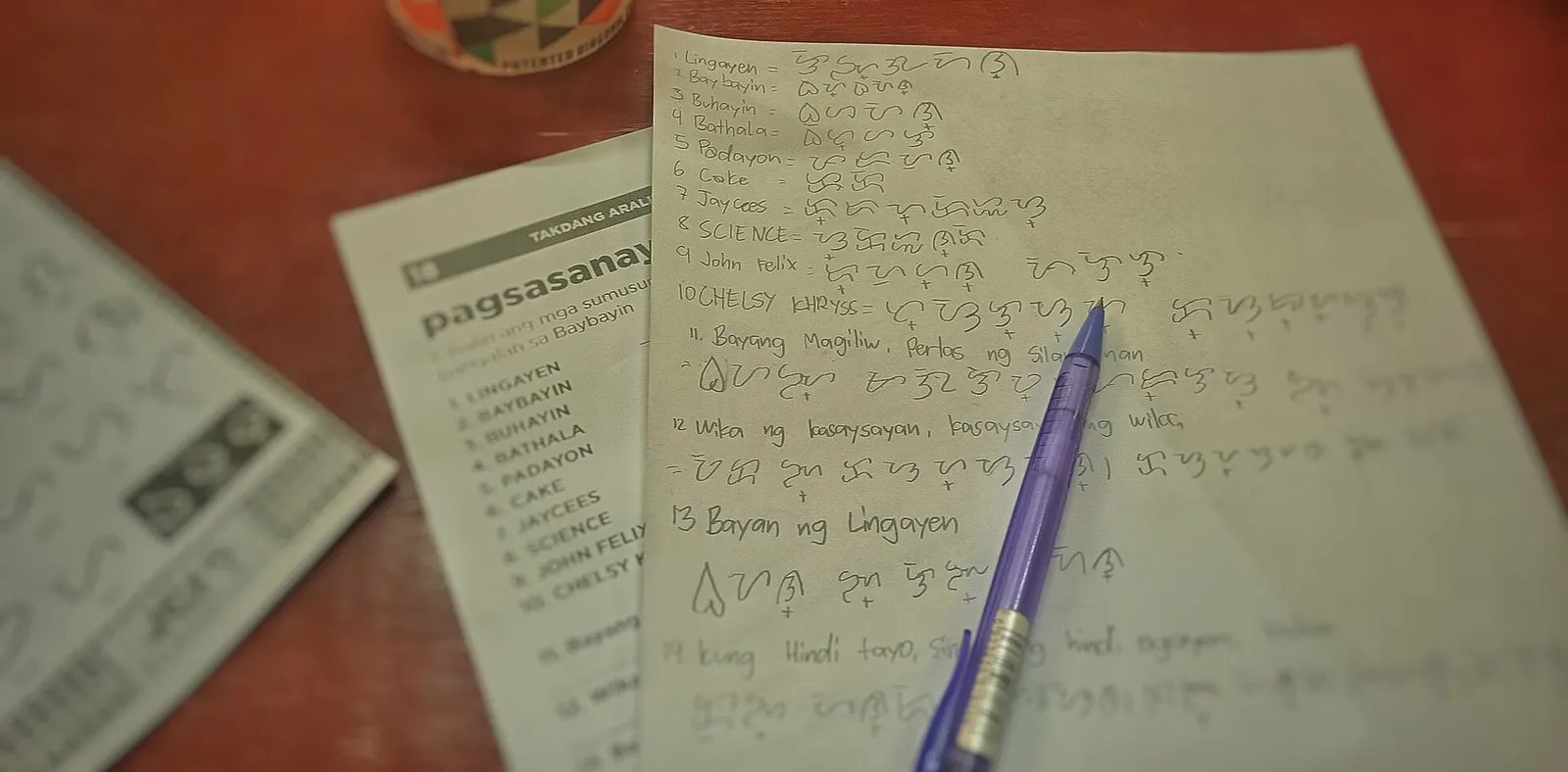
How to write your name in Baybayin
The key rule: write by sound, not by English spelling. Baybayin has no C, F, J, Q, V, X or Z, so you choose the nearest sound.
Break your name into syllables, then match each one.
- Maria: MA, RI, YA. MA plain, RA with a kudlit above (RI), YA plain.
- Ethan: E, TA, N. The vowel character E/I, then TA, then NA with a canceller. The English "th" becomes a T sound.
- Emmanuel: E, MA, NU, E, L. Double letters collapse into one sound, and the final L is LA with a canceller.
- Joseph: often written as DYO, SEP, since Baybayin has no J or F. Some writers use HO, following Spanish pronunciation. Both are reasonable choices.
If your name has several possible spellings, that is normal. Pick the one that sounds right when your family says it.
Is Baybayin the official national script?
No. In 2018, a House of Representatives committee approved House Bill 1022, the proposed National Writing System Act, which aimed to declare Baybayin the national writing system. It did not become law, and similar proposals since then have not been enacted as of this writing. Filipino is officially written in the Latin alphabet.
Some heritage advocates also raised a thoughtful point: the Philippines has several indigenous scripts, and they asked lawmakers to protect all of them, not only the Tagalog one.
You will still see Baybayin in official places. The New Generation series of peso banknotes, for example, includes the word Pilipino written in Baybayin.
A respectful note on tattoos and designs
Baybayin tattoos are a meaningful way for many Filipinos, especially in the diaspora, to wear their heritage. A few gentle suggestions:
- Check with someone who reads it. Misplaced kudlits are common, and a tattoo is a long time to spell your name wrong.
- Avoid automatic translators that convert English spelling letter by letter.
- Decide on the vowel canceller you prefer before you visit the artist.
- Learn what it says so you can tell the story when people ask. They will.
A good test: write it out yourself first. If you can read your tattoo back aloud, you are ready.
Your next step
Try writing your first name in Baybayin on a scrap of paper tonight, then ask a family member to sound it out with you. If you would like a gentler start, our word of the day and kids corner are great places to practice together. Learn at your pace; the script waited centuries for you, and it can wait one more evening.
Questions people ask
How many letters are in the Baybayin alphabet?
Traditional Baybayin has 17 basic characters: 3 vowels (A, E/I, O/U) and 14 consonants. Kudlit marks change each consonant's vowel, and a modern canceller mark lets words end in a consonant.
Is Baybayin the national writing system of the Philippines?
No. A 2018 House bill proposing Baybayin as the national writing system was approved at committee level but did not become law. Filipino is officially written in the Latin alphabet.
Is Baybayin the same as alibata?
They refer to the same script. Alibata is a 20th-century name based on the Arabic alphabet's first letters; many scholars and advocates prefer the older name, Baybayin.
How do I write my name in Baybayin?
Split your name into syllables by sound, not English spelling. Match each syllable to a character, add a kudlit above for e/i or below for o/u, and use a canceller for final consonants.
Is Baybayin still used today?
Yes, as heritage art, in design, in schools and on peso banknotes. Related scripts of the Hanunó'o Mangyan, Buhid and Tagbanwa peoples remain living traditions.