What is a parol?
A parol (pah-ROL) is the star-shaped lantern that lights up Filipino homes, churches, and streets at Christmas. The word comes from the Spanish farol, meaning lantern. In Kapampangan it is parul.
The classic parol is a five-pointed star with two long tails, made from a bamboo frame covered in thin papel de Hapon (Japanese paper). Modern versions use capiz shell, plastic, wire, recycled materials, and LED lights. Whatever the material, the meaning stays the same: a light in the window that says, we are waiting for Christmas, and you are welcome here.
Where the parol comes from
Lanterns have guided Filipino Christmas processions for a long time. Many historians link the parol to the Simbang Gabi, the dawn masses held for nine days before Christmas. Before streetlights, families carried lanterns to light the way to church in the dark. Over time the lantern took on the shape of the star that guided the Magi, and it moved from the procession into the home window.
Today the parol is the single most recognizable symbol of Pasko, the Filipino Christmas season. It also travels well. Many families abroad hang one in their window as a quiet way of saying Filipino house here, and more than a few neighbors have knocked to ask where to get one.
The Giant Lantern Festival of San Fernando
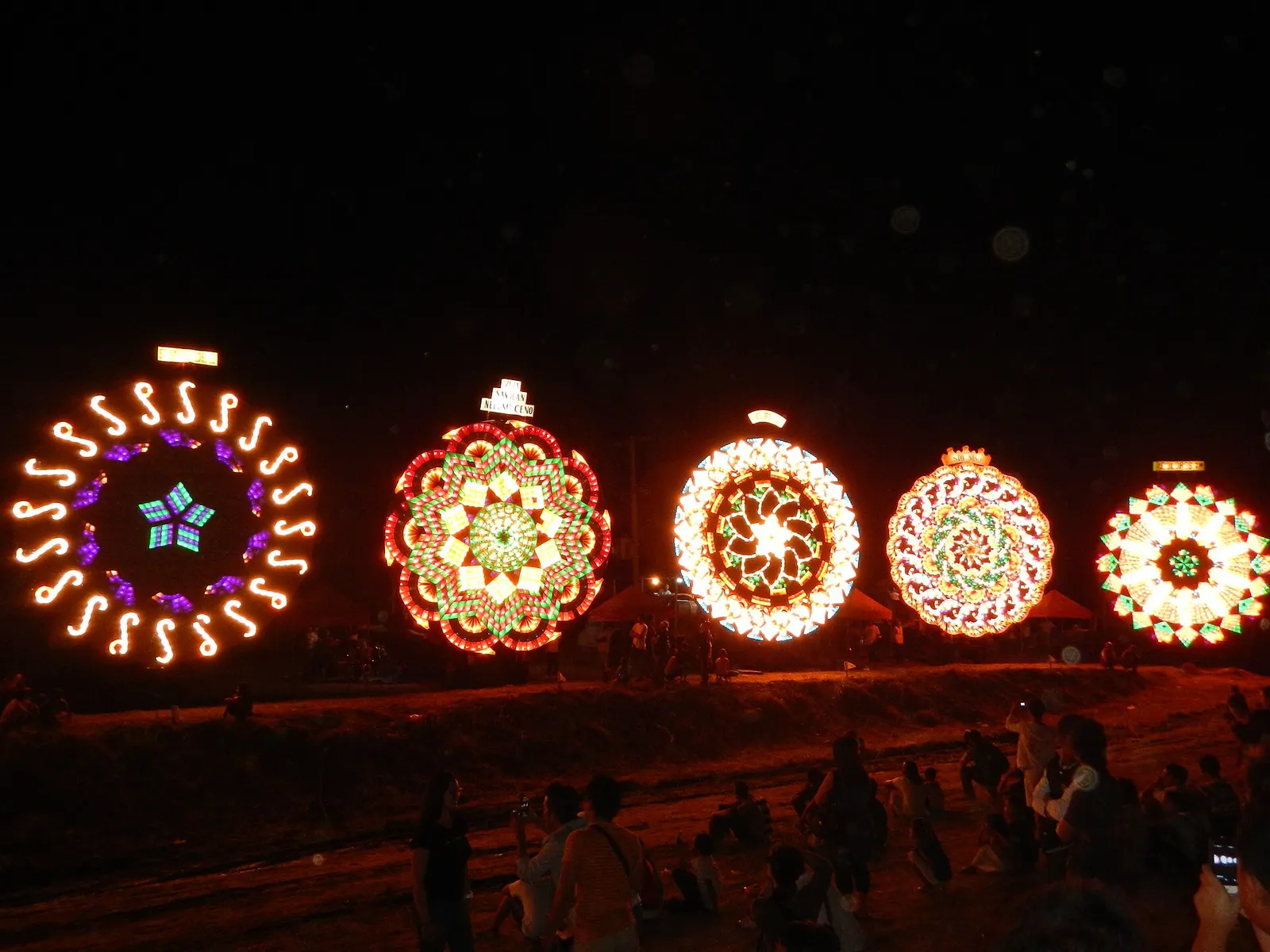
If the parol has a capital, it is San Fernando, Pampanga, often called the Christmas Capital of the Philippines. Its Giant Lantern Festival, known locally as Ligligan Parul, is held every December, usually on the Saturday before Christmas Eve.
The tradition grew out of lantern processions in the early 1900s. When electricity reached the city around 1930 or 1931, lantern makers began adding bulbs, and the contest that followed became the festival we know. Today's giant parols can stand around 20 feet tall and hold thousands of bulbs. Behind each one, a craftsman turns a hand-built rotor of metal and switches, making the lights pulse and swirl like a living kaleidoscope. Barangays (neighborhoods) work for months on their entry, and the skills are often passed from parent to child.
If you ever find yourself in Pampanga in December, it is worth a detour. If not, search for festival videos with your family. Even through a screen, it earns a few gasps.
What the parol symbolizes
Many families read several meanings into one lantern:
- The Star of Bethlehem. The five-pointed star recalls the light that led the Three Kings to the newborn Jesus.
- Hope and light. A parol in the window is a sign of hope in a dark season, which is why many families leave theirs up well into January.
- Welcome. It tells visitors, carolers, and family that this home is celebrating and the door is open.
- Togetherness. Making a parol is a group project. Somebody holds, somebody glues, somebody gives advice nobody asked for.
The Filipino Christmas season famously starts with the "Ber months," so do not be surprised to see a parol go up in September. That is not early. That is right on time.
How to make a simple parol at home
This is a family-friendly version that works for kids from about age five, with an adult helping. It takes about an hour, plus drying time. Our kids corner has more crafts like it.
What you need
- 10 popsicle sticks or thin bamboo skewers of equal length (for skewers, an adult should snip off the sharp tips first)
- 5 short sticks or pieces of skewer, about 2 inches long, for spacers
- White school glue, or a hot glue gun used only by an adult
- Colored tissue paper or crepe paper in two or three colors
- Child-safe scissors and a glue stick
- String or yarn for hanging
- Optional: a battery-powered LED tea light or a short string of battery fairy lights
Steps
- Make the first star. Lay five sticks into a five-pointed star, the way you would draw one without lifting your pencil. Glue each place where two sticks cross. Let it dry fully.
- Make the second star. Repeat with the other five sticks so you have two matching stars.
- Add the spacers. Glue one short stick upright at each of the five inner corners of the first star. Then press the second star on top so the spacers hold the two stars apart. This gives the parol its depth.
- Let it set. Give it at least 30 minutes so the frame feels solid before you cover it.
- Cover the points. Cut tissue paper a little larger than each point of the star. Use a glue stick on the frame and wrap the paper around, front and back. Mixing colors looks lovely.
- Add the tails. Cut two or three long strips of tissue or crepe paper and glue them to the bottom points. The tails are the parol's signature, so be generous.
- Decorate the center. Add a circle of paper, a cut-out of a star, or your family name.
- Light it safely. If you want a glow, tape a small LED light inside or wrap battery fairy lights around the frame.
- Hang it. Tie string to the top point and hang it in a window where it can be seen from outside.
Safety notes for little hands
- Never use real candles inside a paper parol. LED lights only.
- An adult should handle hot glue, craft knives, and any sharp skewer ends.
- Keep battery packs out of reach of very young children.
Keeping the tradition when you live far away
Many Filipino families abroad say that the first time they hung a parol in their own home, it finally felt like Christmas. If you grew up without one, you are not late. A parol made at the kitchen table this year is as real as one carried to Simbang Gabi a century ago.
Some families make a new parol every year and keep the old ones, so the window slowly becomes a record of who was small and who learned to glue straight. Others buy a capiz parol from a Filipino shop and pass it down. Both are beautiful.
Your next step
If you have an afternoon free, gather some sticks and tissue paper and make one together. Then read about Simbang Gabi, the dawn masses the parol once lit the way to, or explore the rest of Pasko at your own pace. Maligayang Pasko.
Questions people ask
What does a parol symbolize?
A parol represents the Star of Bethlehem that guided the Three Kings. Many families also see it as a symbol of hope, light, and welcome during the Christmas season.
When do Filipinos put up the parol?
Many families put up their parol in September, at the start of the "Ber months," and keep it up until early January, often through the Feast of the Three Kings.
What is the Giant Lantern Festival?
It is an annual December festival in San Fernando, Pampanga, where barangays compete with huge electric parols, some around 20 feet tall, whose lights are animated by hand-operated rotors.
What is a parol traditionally made of?
Traditionally, a bamboo frame covered with thin papel de Hapon (Japanese paper). Today parols are also made of capiz shell, plastic, wire, recycled materials, and LED lights.
Is it safe for kids to make a parol?
Yes, with a few precautions. Use popsicle sticks and white glue, let an adult handle hot glue and sharp ends, and use only battery LED lights, never candles.