
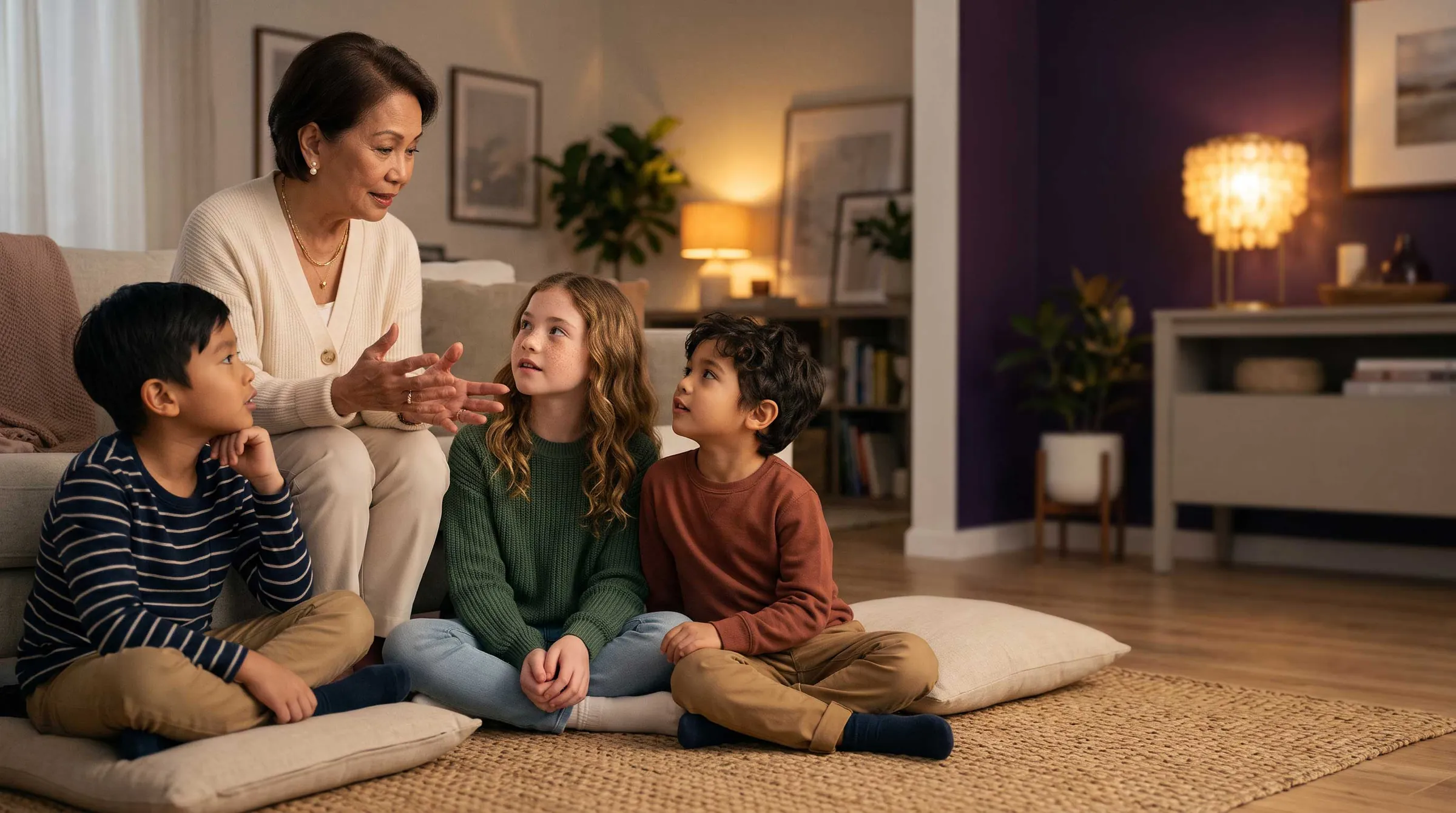
It usually happens at a family party. A tita asks you something in Tagalog, everyone turns to look, and you freeze. You understand maybe half of it. You answer in English. Someone laughs, kindly enough, and says, "Ay, you're so American." You laugh too. But on the drive home, a quiet thought follows you: maybe I'm not Filipino enough.
If that feeling is familiar, I want to start by saying this clearly: it is not a verdict. It's a feeling, and a very common one. Many Filipino-Americans, kids of mixed families, adoptees and children of immigrants everywhere carry it. You can set it down.
Where the feeling comes from
I moved from Cagayan de Oro to Skokie, Illinois, in 1983, when I was ten. I kept my Bisaya, but I watched friends lose their family languages within a few years. Nobody chose that. School was in English, parents worked long hours, and many immigrant parents believed English was the safest gift they could give their children.
Then there is hiya, a Filipino word often translated as "shame," though it's closer to a deep sense of propriety and not wanting to look foolish in front of others. (Learn more about hiya.) Hiya keeps many of us from practicing a language out loud or asking "basic" questions at family gatherings. So the gap grows, not from lack of love, but from fear of getting it wrong.
My son Ethan grew up in Chicago and Glenview. He's Filipino-American through and through, and he's had his own version of this feeling. Watching him work through it taught me something: reconnecting is less about catching up and more about showing up.
There is no test at the door
Being Filipino isn't a score. It isn't measured by how much Tagalog you speak, how much bagoong you can handle, or whether you've been to the Philippines. Our culture has always made room for mixture: Malay, Chinese, Spanish, American, and the dozens of regional cultures across more than 7,000 islands. Filipinos have been blending for centuries. A mixed family is not a departure from that story. It is that story.
There's a Filipino value I love called kapwa, the sense of a shared self, that you and I are connected at a level deeper than our differences. (Read about kapwa.) Kapwa doesn't ask for credentials. It just says: you're one of us.
A gentle path back, one step at a time
Here's what I suggest, especially if you don't know where to begin. Pick one. Not all of them. Culture is a lifelong salu-salo, a shared meal, not a final exam.
1. Start with food
Food is the most welcoming door in Filipino culture. Cook one dish you remember from childhood, or one you've always been curious about. Chicken adobo is a classic first step, and our Filipino food guide explains the why behind the dishes. Then call someone who made it for you and ask how they do it. That call matters as much as the recipe.
2. Learn five words, not five hundred
You don't need fluency to feel connected. Start with words you'll actually use: salamat (thank you), kain tayo (let's eat), ingat (take care), mano po (the respectful greeting to elders), and mahal kita (I love you). Our Tagalog phrases guide is built for exactly this. If your family speaks Bisaya, Ilocano or another language, learn their words. Those count just as much.
3. Learn who's who in the family
Filipino families have a beautiful vocabulary of respect: Lolo and Lola, Tito and Tita, Kuya and Ate. Using them is an instant, warm signal of belonging. See our Filipino family terms guide.
4. Ask an elder for one story
Not an interview. One story. "What was Christmas like when you were little?" "How did you meet Lolo?" Elders often light up when asked. Write it down or record it with permission. Those stories are heirlooms.
5. Learn the history that includes you
Filipino-American history goes back further than many people realize. October is Filipino American History Month in the United States, marking the 1587 landing of Filipino sailors aboard a Spanish galleon at what is now Morro Bay, California. Our Filipino-American history guide walks through it. Knowing that you're part of a long story changes how you carry the present one.
6. Make something with your hands
Make a parol, the star lantern of Filipino Christmas, with our parol guide. Or learn to write your name in Baybayin, a pre-colonial Philippine script. Making something gives your heritage a physical place in your home.
For mixed families
If you're raising kids in a mixed family, or you grew up in one, you don't have to choose. Your children can be Filipino and Mexican, Filipino and Irish, Filipino and Korean. Each culture adds to the table; none subtracts.
A few ideas that many families find helpful:
- Name the heritage out loud. "This is how Lola makes it" teaches more than any lesson.
- Celebrate both calendars. Simbang Gabi and Día de los Muertos, Noche Buena and Lunar New Year. More feasts, more joy.
- Let the non-Filipino parent learn too. A dad practicing "salamat po" at a family party is a beautiful thing, and the titas will adore him for trying.
- Lead with curiosity, not quizzes. Invite kids in. Never test them.
For the person who feels behind
If you're 25 or 45 or 65 and you feel like you missed your chance, please hear me: you didn't. I know people who learned their first Tagalog sentences at retirement and cried the first time they spoke them to a cousin in Manila. There is no expiration date on belonging.
And to the titas and titos reading this, with love: when a young person tries a word and gets it a little wrong, cheer. A smile does more than a correction. (Save the teasing for their dancing at the reunion.)
Being Filipino is something you carry, grow and share. You don't have to earn it. You just have to keep it close.
Your next step
Today, pick one small thing. Learn one word from our Salita word of the day. Cook one dish. Text one elder: "Can you tell me a story about when you were young?"
That's it. That's how reconnecting starts, not in one big leap, but in small, warm steps, taken at your own pace. We'll be here for every one of them.
Ingat, and welcome home.
Emmanuel